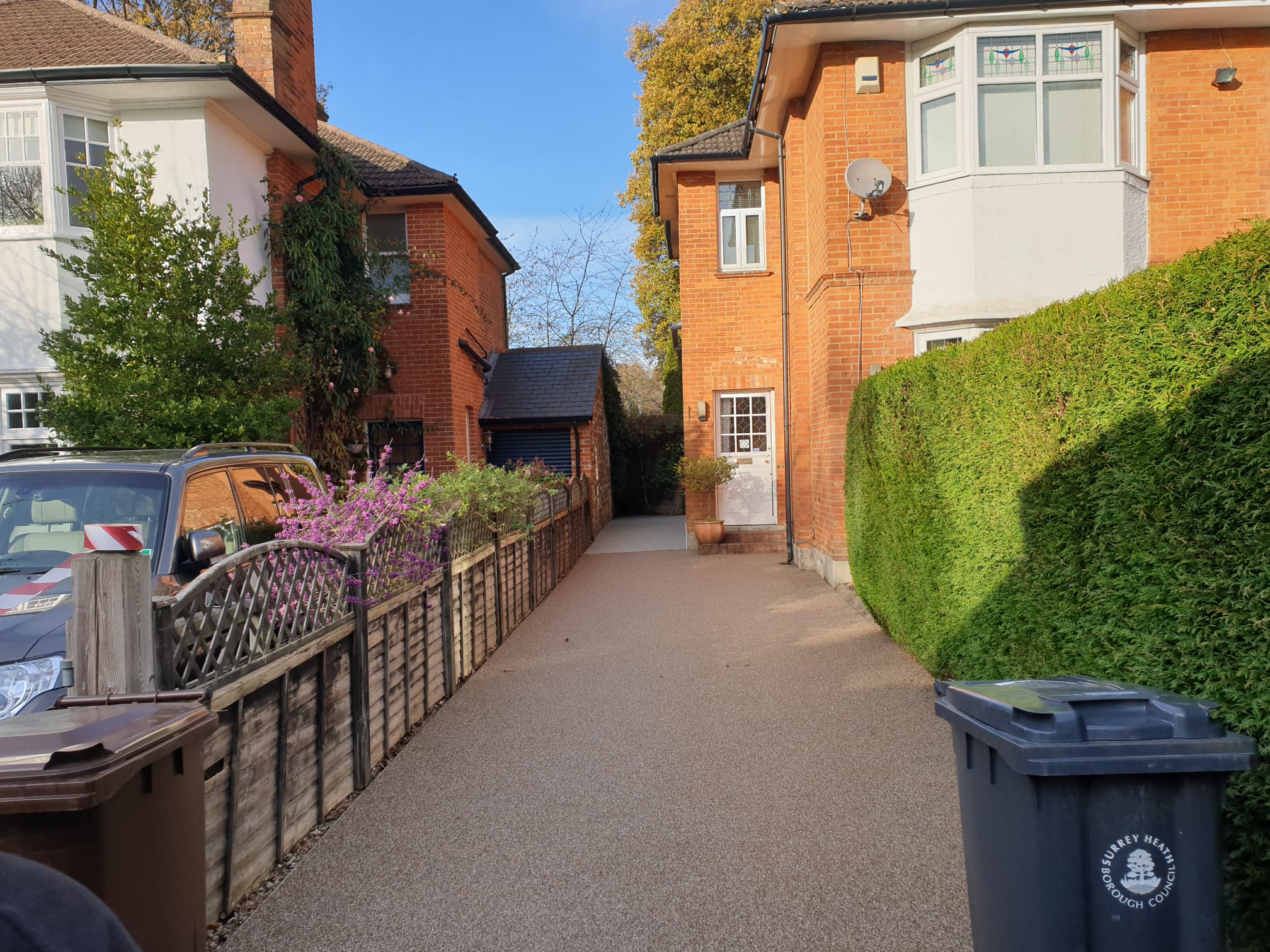
Resin Bound vs Resin Bonded — A Hampshire Homeowner Guide to Getting It Right
Most resin driveway quotes in Hampshire do not tell you upfront which system is being offered — resin bound or resin bonded. The two products look similar in marketing photos but behave very differently over 10–20 years. Here is what you need to know before signing anything.
The Core Difference: Encapsulated vs Scattered Stone
In a resin-bound system, aggregate and resin are mixed together in a forced-action mixer before laying — every stone is fully encapsulated in the resin matrix. The result is a solid, unified surface. In a resin-bonded system, the contractor applies resin to the base first, then scatters aggregate on top. Only some stones bond fully; others remain partially attached and shed over time. The difference is fundamental to how the surface behaves after installation — and how long it lasts.
SuDS Compliance: Why Permeability Determines Planning Permission
Resin-bound surfaces are permeable — water drains vertically through the aggregate matrix into the sub-base, meeting SuDS requirements without additional drainage infrastructure. This means resin-bound qualifies as permitted development for new front driveways in Hampshire, with no planning application required. Resin-bonded is impermeable — it drains like tarmac or concrete — and therefore requires planning permission for any new front driveway over 5m. This single difference can add weeks and cost to a project, and is a primary reason why Hampshire homeowners should insist on resin-bound.
Long-Term Cost: The 20-Year Comparison
Resin-bonded costs less upfront, but that gap closes quickly. A resin-bonded surface typically needs replacing at 8–12 years as surface stone thins. A resin-bound driveway, properly installed with UV-stable aliphatic resin, performs for 20+ years with only an annual pressure wash. Our 10-year installation guarantee covers the first half of that lifespan. When you factor in replacement cost for resin-bonded, resin-bound is cheaper over any horizon beyond 6–8 years in Hampshire.
Frequently Asked Questions
What should I ask a contractor before accepting a driveway quote?
Ask directly: is this resin bound or resin bonded? Ask them to specify the resin system in writing — UV-stable aliphatic or aromatic — and whether the finished surface will be SuDS-compliant. A legitimate resin-bound installer will answer all three questions without hesitation.
Can you lay resin bound over resin bonded?
In most cases, no — or at least not advisably. A resin-bonded surface is not a stable sub-base because the stone layer can flex or debond. If you have an existing resin-bonded driveway, the correct approach is to assess the base beneath it and relay from scratch, applying resin-bound directly to the original sub-base rather than over the resin-bonded layer.
Does resin bonded look different from resin bound?
Both can look similar when freshly installed. The difference becomes apparent within 1–3 years: resin-bonded surfaces develop bare patches where stones have shed, while resin-bound maintains a consistent, uniform texture. In wet conditions, resin-bonded also produces more surface run-off — a sign the surface is not draining through the matrix.
Is resin bonded banned in Hampshire?
No — it is not banned, but it requires planning permission for new front driveways over 5m because it is impermeable. Many installers in Hampshire still offer it for rear drives, paths, and commercial areas where planning rules are less restrictive. Always check planning requirements before committing to either system.
Get a Free Quote in Hampshire
Call 07384 599889 or request a free quote online. See all our seasonal driveway services.